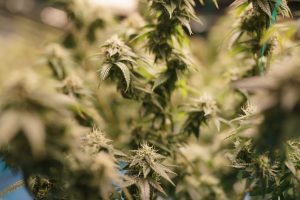
Not every cannabis bud develops into a large, dense flower. Some grow smaller, lighter, and less compact than the buds typically featured in dispensary photos. Growers often refer to this type of flower as cannabis larf.
Although the term might sound negative, larf isn’t necessarily defective cannabis. Instead, it describes a particular type of flower structure that can develop because of plant genetics, lighting, and growing conditions.
Understanding why these smaller buds form can help consumers better evaluate cannabis beyond appearance alone.
What Is Cannabis Larf?
Cannabis larf refers to small, airy, loosely structured flower that typically develops on the lower or less-exposed portions of a cannabis plant.
Unlike dense buds that form near the upper canopy, larf often contains smaller clusters of flowers with more space between them.
Common characteristics include:
- Small or lightweight buds
- Loose flower structure
- Lower density
- More visible leafy material
- Less uniform appearance
However, these characteristics don’t automatically determine the flower’s cannabinoid content or overall quality.
Why Does Cannabis Larf Develop?
One of the biggest factors is light exposure.
During cultivation, the upper portions of a cannabis plant often receive more direct light than the lower branches.
As a result, flowers developing beneath a dense canopy may receive less energy for growth.
This can contribute to smaller, less-developed buds.
Other factors may include plant genetics, canopy structure, growing conditions, and cultivation techniques.
For example, a particularly dense plant canopy can limit the amount of light reaching lower flower sites.
Does Cannabis Larf Have Less THC?
Not necessarily.
Although smaller buds may develop under less favorable lighting conditions, their appearance alone doesn’t establish their THC percentage.
Cannabinoid concentrations can vary across different parts of a cannabis plant. However, the relationship depends on genetics, environment, plant development, and other factors.
Therefore, consumers shouldn’t assume that every airy bud contains less THC than every dense bud.
Laboratory testing provides a more reliable measurement of cannabinoid content than flower size.
Larf vs. Popcorn Buds
These terms sometimes overlap, but they don’t always mean the same thing.
Popcorn buds generally refer to smaller cannabis flowers that resemble pieces of popcorn.
Larf, meanwhile, emphasizes a loose, airy, or underdeveloped flower structure.
A popcorn bud can still be relatively dense and well-developed despite its small size.
Larf tends to have a less compact structure.
Understanding the difference helps explain why cannabis products with smaller buds can vary significantly in appearance and quality.
Can Growers Prevent Larf?
Cultivators often use canopy-management techniques to improve light distribution throughout their plants.
These techniques may include pruning, training, and removing lower growth that receives insufficient light.
By managing plant structure, growers can direct resources toward flower sites with better growing conditions.
However, not every airy flower results from poor cultivation.
Some cultivars naturally develop looser structures because of their genetics.
Is Cannabis Larf Used in Other Products?
Yes.
Smaller or less visually appealing flower can still contain cannabinoids and terpenes.
Depending on quality, testing, and processing requirements, producers may use this material in products such as:
- Ground flower
- Pre-rolls
- Cannabis extracts
- Infused products
However, consumers shouldn’t assume every pre-roll or extract contains larf. Starting materials and quality standards vary between manufacturers.
What Does Research Say About Flower Position?
Researchers have studied how flower location within a cannabis plant affects cannabinoid concentration and development.
A study published in Frontiers in Plant Science examined cannabinoid distribution across different positions on cannabis plants and found that flower position and light exposure can influence cannabinoid accumulation.
Read the research on cannabis flower position and cannabinoid distribution.
This research helps explain why cultivators pay close attention to canopy structure and flower development, although it doesn’t establish that all small buds are necessarily less potent.
Why Appearance Isn’t Everything
Large, dense buds often attract attention because of their visual appeal.
However, flower quality involves much more than size.
When evaluating cannabis, consider:
- Cannabinoid profile
- Terpene information
- Aroma
- Freshness
- Genetics
- Cultivation
- Drying and curing
- Laboratory testing
A smaller bud isn’t automatically a poor product, just as a large flower isn’t automatically premium.
For more information about how genetics and growing conditions influence cannabis appearance, read our guide to cannabis phenotypes and flower variation.
Final Thoughts on Cannabis Larf
Cannabis larf describes small, airy flower that often develops in lower-light portions of the cannabis plant.
Although these buds may look different from dense, premium flower, appearance alone doesn’t determine cannabinoid content or overall quality.
Genetics, cultivation, light exposure, and post-harvest handling all influence the finished product.
At Orange County Cannabis Co., we believe understanding these differences helps consumers make more informed decisions and appreciate the many factors that shape cannabis flower.